From Hierarchy to Intelligence cover image

Wookyoung Kim · April 2, 2026

From Hierarchy to Intelligence

On February 26, 2026, Block decided to reduce its workforce by 40 percent. Jack Dorsey said the decision was possible because AI and small, horizontal teams could deliver the same results.

Thirty-three days later, on March 31, 2026, Jack Dorsey published a piece titled "From Hierarchy to Intelligence" on Block's website with Roelof Botha, a Sequoia partner and major shareholder.

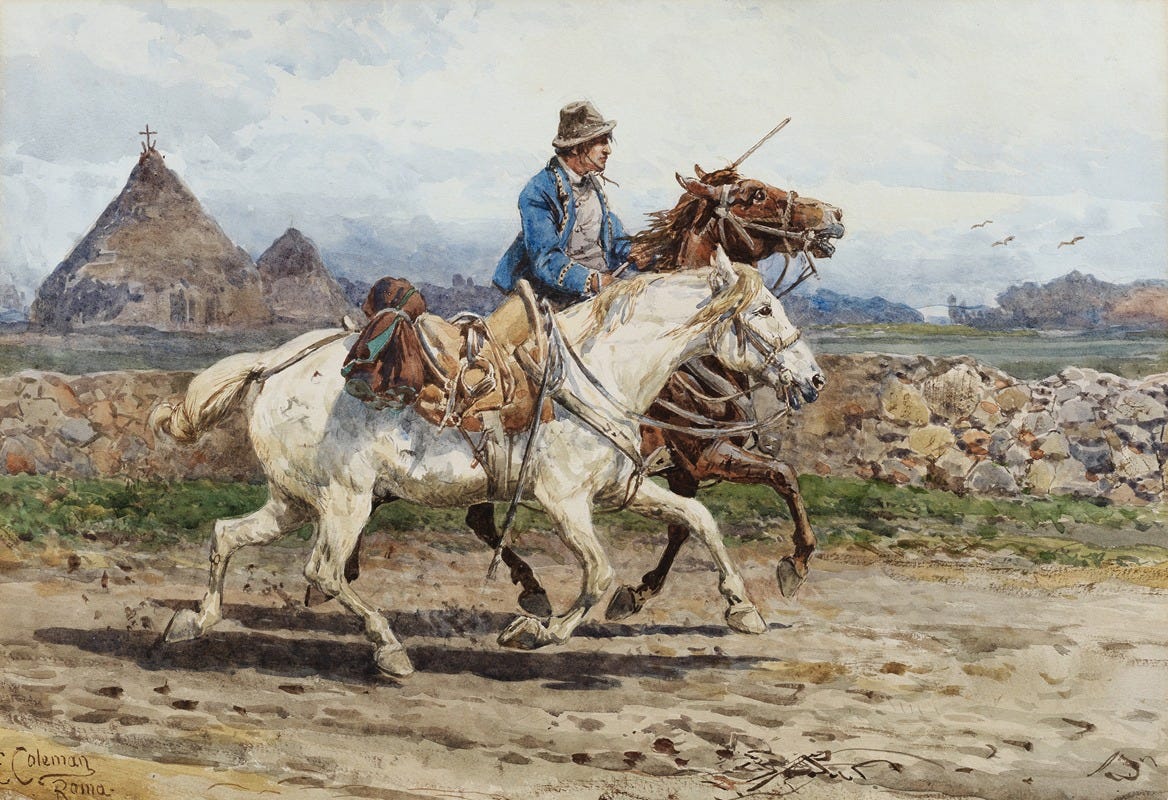
Henry Enrico Coleman (Italian, 1846-1911), Buttero Riding in the Roman Campagna. From Hierarchy to Intelligence. At Sequoia, we have seen that speed is the strongest predictor of startup success. Most companies see AI as a productivity tool. Few pay attention to the possibility that AI can change the way we collaborate. Block is showing what it looks like to fundamentally reimagine organizational design, ultimately using AI to turn speed into a compounding competitive advantage.

Two thousand years before the first corporate org chart was created, the Roman army solved the problem every large organization still faces today: how do you coordinate thousands of people spread across vast territory with only limited means of communication?

Rome's answer was a nested hierarchy with a consistent span of control at every level. The smallest unit was the contubernium: eight soldiers sharing a tent, equipment, and one mule under the command of a decanus. Ten squads formed a centuria of 80 under a centurion. Six centuriae formed a cohort, and ten cohorts formed a legion of about 5,000. At every level, a designated commander had clear authority, aggregated information from below, and transmitted decisions from above. This structure, 8 -> 80 -> 480 -> 5,000, was an information pathway designed around simple human limits: one commander can effectively manage between three and eight people. The Romans discovered this through centuries of war. Even today, the U.S. Army's hierarchical command structure follows a similar pattern. We now call it "span of control," and it remains the constraint governing every large organization on earth.

The next major shift came from Prussia. After Napoleon's army crushed the Prussian forces at Jena in 1806, reformers led by Scharnhorst and Gneisenau rebuilt the army around an uncomfortable truth: you cannot rely on the genius of the individual at the top. You need a system. They created the General Staff, a professional officer class whose job was not combat, but operational planning, information processing, and coordination across units. Scharnhorst intended these staff officers to "assist incompetent generals, providing the talents a commander might lack." This was middle management before the term existed: a class of specialists designed to transmit information, pre-process decisions, and maintain alignment across a complex organization. The army also formalized the distinction between line and staff functions. Line performs the core mission. Staff provides specialized support. Every company still uses this vocabulary today.

Military hierarchy entered the corporate world through American railroads in the 1840s and 1850s. The U.S. Army sent engineering officers trained at West Point into private railroad companies, and those officers brought military organizational thinking with them. Line-and-staff hierarchy, divisional structure, bureaucratic systems of reporting and control - all of this had been developed first in the military before railroads adopted it. In the mid-1850s, Daniel McCallum of the New York and Erie Railroad created the world's first org chart to manage more than 500 miles of track and thousands of employees. The informal management style that worked for smaller railroads no longer worked. People were dying in train collisions. McCallum's chart formalized the same hierarchical logic the Romans had used: layers of authority, clear reporting lines, and structured information flow. It became the blueprint for the modern corporation.

Frederick Taylor (1856-1915), often called the father of scientific management, optimized what happened inside that hierarchy. Taylor broke work into specialized tasks, assigned them to trained experts, and managed through measurement rather than intuition. This produced the functional pyramid organization: a structure optimized for efficiency on top of the information pathways pioneered by the military and commercialized by the railroads.

The first serious stress test for functional hierarchy was World War II. The Manhattan Project required physicists, chemists, engineers, metallurgists, and military officers to collaborate across disciplinary boundaries toward a single goal under extreme secrecy and time pressure. Robert Oppenheimer organized Los Alamos Laboratory into functional divisions, but resisted the military's instinct for compartmentalization and insisted on open collaboration across divisions. When the implosion problem, the rapid collapse of an object under external pressure, became urgent in 1944, he reorganized the laboratory around that problem and created cross-functional teams unlike anything seen in American corporations at the time. It worked. But it was the result of an exceptional wartime situation led by one extraordinary person. The question facing the postwar corporate world was whether this kind of cross-department collaboration could be made routine.

After World War II, as corporations grew and globalized, the scaling limits of functional organization became severe. In 1959, McKinsey's Gilbert Clee and Alfred di Scipio published "Creating a World Enterprise" in Harvard Business Review, laying out the intellectual framework for the matrix organization, which combined functional expertise with divisional organization. Under Marvin Bower's leadership, McKinsey helped companies such as Shell and GE adopt these principles and balance central standards with local agility. This became the archetype of the professional, or modern, corporation that powered the postwar global economy.

Over time, other frameworks emerged to address the complexity, rigidity, and bureaucracy of matrix structures. The McKinsey 7-S framework, developed by Tom Peters and Robert Waterman in the late 1970s, distinguished between the "hard S" elements - strategy, structure, and systems - and the "soft S" elements - shared values, skills, staff, and style. The core idea was that structural elements alone were not enough. Organizational effectiveness also requires alignment around cultural characteristics and the human factors that determine whether strategy is executed.

In more recent decades, technology companies have experimented aggressively with organizational structure. Spotify popularized cross-functional squads with short sprint cycles. Zappos tried holacracy and eliminated management titles entirely. Valve adopted a flat structure and operated without a formal hierarchy.

Spotify's squads: an operating model Spotify introduced around 2012. Small cross-functional teams of roughly eight people, called squads, served as the basic unit; squads sharing the same function were grouped into chapters, and related squads were grouped into tribes. Holacracy: a structure that removes manager titles and traditional hierarchy, distributing authority through "circles" and "roles." Valve: the U.S. game company and operator of Steam, known for a flat organization in which employees autonomously choose and move between projects without formal titles.

Each of these experiments revealed something about the limits of traditional hierarchy, but none solved the fundamental problem. As Spotify scaled, it reverted to traditional management. Zappos experienced significant employee attrition. Valve's model was difficult to scale beyond a few hundred people. When organizations grow to thousands of people, they return to hierarchical coordination because there has been no alternative information pathway powerful enough to replace it.

The constraint is the same one the Roman army faced and the Marines rediscovered in World War II. Narrow the span of control and you add command layers; add command layers and information flow slows down. Two thousand years of organizational innovation have been attempts to work around this tradeoff without breaking it.

So what is different now?

At Block, we are questioning a fundamental premise: that organizations must be structured hierarchically, using humans as the coordination mechanism. We are trying to replace the function that hierarchy itself performs. Most companies using AI today give every employee a copilot, making the existing structure a little more efficient without changing the structure itself. What we are pursuing is different: a company built as one intelligence, or a mini AGI.

We are not the first to try to move beyond traditional hierarchy. Haier's Rendanheyi model, platform organizations, and data-driven management were all serious attempts at the same problem. What they lacked was a technology that could actually perform the coordination function that makes hierarchy necessary in the first place. AI is that technology. For the first time in history, a system can maintain a continuously updated model of the entire company and use it to coordinate work - the kind of coordination that previously had to depend on humans passing information through management layers.

Rendanheyi is a management model adopted by Haier, a Chinese home-appliance manufacturer, starting in 2005. It broke an 80,000-person organization into more than 4,000 microenterprises of 10 to 20 people, each allowed to manage its own profit and loss, make its own decisions, and even hire externally.

For this to work, two things are necessary: a kind of world model of the company's own operations, and customer signals rich enough to make that model practically useful.

Block is a remote-first company. Everything we do leaves a record: decisions, discussions, code, design, plans, problems, progress. All of it exists as recorded action. This is the raw material for the company world model. In a traditional company, a manager's role is to understand what is happening across the team and pass that context up and down. In a remote-first company where work already happens in machine-readable form, AI can continuously build and maintain that picture: what is being built, where things are blocked, where resources are allocated, what is working, and what is not. This is the information hierarchy used to transmit. The company world model takes over that role.

But the system's capability depends on the quality of the customer signals that feed it. And money is the most honest signal in the world.

People lie in surveys. They ignore ads. They abandon carts. But when they spend, save, send, borrow, and repay money, that is the truth. Every transaction is a fact about someone's life. Block sees millions of these transactions every day from both sides: the buyer side through Cash App, the seller side through Square, plus merchant business operations data. This gives the customer world model something rare: an understanding of customer-by-customer and merchant-by-merchant financial reality, built from honest signals and compounding over time. The richer the signals, the more precise the model. The more precise the model, the more transactions it drives. The more transactions it drives, the richer the signals become.

Together, the company world model and customer world model form the foundation for a different kind of company. Instead of product teams following predetermined roadmaps, we build four things.

First, capabilities: atomic financial primitives such as payments, lending, card issuing, banking, buy-now-pay-later, and payroll. These are not products. They are hard-to-acquire and hard-to-maintain building blocks, some carrying network effects and regulatory licenses. They do not have their own UI. They have reliability, compliance, and performance goals.

Second, world models. There are two sides here. The company world model is how the company understands its own operations, performance, and priorities, replacing the information that once flowed through management layers. The customer world model is a customer-by-customer, merchant-by-merchant, and market-by-market representation built from proprietary transaction data. It starts with raw transaction data today, but over time it evolves into a full causal and predictive model.

Third, the intelligence layer. This is the layer that combines capabilities into solutions for specific customers at specific moments and delivers them proactively. A restaurant's cash flow is tightening ahead of a seasonal low the model has observed before. The intelligence layer composes a short-term loan from the lending capability, uses the payments capability to adjust the repayment schedule, and presents it before the merchant has even thought about financing. A Cash App user's spending pattern changes in a way the model associates with moving to a new city. The intelligence layer combines a new direct deposit setup, a Cash App Card with Boost categories tuned to the new neighborhood, and savings goals adjusted to updated income. No product manager planned either of these solutions. The capabilities already existed. The intelligence layer recognized the moment and assembled them.

Fourth, interfaces, both hardware and software. Square, Cash App, Afterpay, TIDAL, bitkey, and proto belong here. They are the surfaces through which the intelligence layer delivers its composed solutions. They are important, but they are not where value is created. The value is in the models and the intelligence.

When the intelligence layer tries to compose a solution and fails because the required capability does not exist, that failure signal becomes the future roadmap. The traditional roadmap, in which a product manager forms hypotheses about what to build next, is ultimately a constraint in any company. In this model, customer reality generates the backlog directly.

If a company builds this, the question becomes: what do people do?

The organizational structure follows from this and inverts the traditional picture. In a conventional company, intelligence is distributed among people and hierarchy routes it. In this model, intelligence is in the system. People are at the edge. The edge is where action happens.

The edge is where intelligence comes into contact with reality. People reach into places the model cannot yet reach. They sense what the model cannot sense: intuition, subjective direction, cultural context, the dynamics of trust relationships, the mood in the room. They make judgments the model should not make on its own, especially ethical decisions, unprecedented situations, and high-risk moments where the cost of being wrong is severe. A world model that cannot touch the world is only a database. But the edge does not need a management layer for coordination, because the world model gives everyone at the edge the context they need to act. There is no need to wait for information to travel up and down a chain of command.

In practice, this means the organization normalizes around three roles.

ICs, or individual contributors, build and operate the capabilities, models, intelligence layer, and interfaces. They are specialists with deep expertise in a specific layer of the system. Because the world model provides the context managers used to provide, ICs can make decisions about their layer without waiting for instructions.

DRIs, or directly responsible individuals, own specific cross-functional problems, opportunities, or customer outcomes. A DRI might own merchant churn in a particular segment for 90 days and have full authority to pull resources as needed from the world model team, the lending capability team, and the interface team. A DRI may stay with one problem or move elsewhere to solve a new one.

Player-coaches combine building with developing people. They replace traditional managers whose primary job was the information pathway. Player-coaches still write code, build models, or design interfaces. At the same time, they invest in the growth of people around them. They do not spend their days in status meetings, alignment sessions, or priority negotiations. The world model handles alignment. The DRI structure handles strategy and priorities. Player-coaches are responsible for craft and people.

There is no need for a permanent layer of middle management. Everything else hierarchy used to do is coordinated by the system, and everyone is empowered, with roles much closer to the work and the customer.

Block is in the early stages of this transition. It will be difficult, and some things will probably break before they work. The reason we are writing this now is that we believe every company will eventually face the same question we are facing: what does your company understand that is truly hard to understand, and is that understanding getting deeper every day?

If the answer is nothing, AI is just a cost-optimization story: cut headcount, improve margins for a few quarters, and eventually get absorbed by something smarter. If the answer is deep, AI does not augment the company. It reveals what the company really is.

Block's answer is the economic graph: millions of merchants and consumers, both sides of every transaction, and financial behavior captured in real time. This understanding compounds every moment the system operates. We believe the underlying pattern - a company organized as one intelligence rather than a hierarchy - is meaningful enough to change how every kind of company operates over the coming years. Block has gone far enough to show that this idea is not merely theoretical, though we welcome discussion and feedback that will test and refine our thinking.

Companies move quickly or slowly according to how information flows. Hierarchy and middle management obstruct information flow. For two thousand years, from the Roman contubernium to today's global corporations, we had no real alternative. Eight soldiers sharing a tent needed a decanus. Eighty people needed a centurion. Five thousand needed a legatus. The question was not whether hierarchy was necessary. It was whether humans were the only option for the work that hierarchy does. They no longer are. Block is building what comes next.